
How Does EIBOR Actually Work? A Simple Guide for Dubai Property Buyers
You have found a mortgage product you like. The rate looks competitive. Then you notice the fine print—"3M EIBOR + 1.75%"—and suddenly you are not sure what you are agreeing to, what it will cost you next year, or whether fixed is the smarter choice.
EIBOR is not complicated. But it is misunderstood by the majority of Dubai property buyers — and that misunderstanding leads to real financial consequences. Buyers who do not understand how the rate resets accept terms they would have negotiated differently. Buyers who do not track where EIBOR is heading choose the wrong mortgage structure at the wrong moment. And buyers who have never seen a stress test calculation wonder why the bank approved them for less than they expected.
At Mortgage Market, we have been arranging mortgages across Dubai and the UAE for over 15 years and more than AED 3 billion in completed transactions. EIBOR comes up in almost every conversation. This guide covers it completely — what it is, how it moves your payment, how it interacts with fixed and variable products, and what the current rate environment in 2026 means for anyone buying or refinancing in Dubai today.
If you want your numbers first, the mortgage calculator UAE on our platform runs the comparison between fixed and EIBOR-linked repayments side by side, instantly. If you want to understand what those numbers mean, read on.
| 📋 What You'll Learn in This Guide |
|---|
| What EIBOR is and how it is set each day in the UAE |
| How EIBOR is used to price your mortgage — with real AED examples |
| The difference between 1-month, 3-month, and 6-month EIBOR tenors |
| How fixed, variable, and hybrid mortgage structures work |
| What happens to your payment when EIBOR moves up or down |
| Where EIBOR is in 2026 — and what that means for your decision |
| When a mortgage buyout makes sense in the current rate environment |
Section 1: What EIBOR Is and How It Is Set
The Definition That Actually Makes Sense
EIBOR stands for the Emirates Interbank Offered Rate. It is the interest rate at which UAE banks lend money to each other — overnight, weekly, monthly, quarterly, and annually. The Central Bank of the UAE publishes the rate every business day based on submissions from a panel of contributing banks.
Think of it as the UAE banking system's internal cost of money. When that cost rises, banks pass it on to borrowers. When it falls, the benefit — for those on variable rate products — flows back through the system.
EIBOR is not the rate you pay on your mortgage. It is the floating base that your bank builds your rate on top of. Your actual mortgage rate is EIBOR plus the bank's fixed margin — and only the EIBOR component moves.
The Four Tenors — and Why the Distinction Matters
EIBOR is published at four main timeframes, called tenors:
| Tenor | Published Daily | Most Common Use |
|---|---|---|
| 1 Month (1M EIBOR) | Yes | Some personal loan products |
| 3 Month (3M EIBOR) | Yes | Most UAE home loans |
| 6 Month (6M EIBOR) | Yes | Some commercial products |
| 1 Year (1Y EIBOR) | Yes | Rare for residential mortgages |
The tenor your mortgage is linked to determines how often your rate resets. A loan linked to 3M EIBOR resets every 90 days — meaning your monthly payment can change up to four times per year. A loan linked to 1M EIBOR resets monthly, making it the most reactive to market movement in either direction.
When comparing mortgage products in Dubai, the tenor is listed in the product terms — usually written as "1M EIBOR + margin" or "3M EIBOR + margin." Most UAE home loans use 3-month EIBOR. When you compare current products across lenders on Mortgage Market, this detail appears in each offer — look for it before you focus on the headline rate.
Who Controls EIBOR — and What Moves It
The Central Bank of the UAE sets the framework, but EIBOR itself reflects actual interbank lending conditions. The primary force driving it is the US Federal Reserve.
Because the UAE dirham is pegged to the US dollar, the UAE cannot independently set its own interest rate policy in the way that, say, the European Central Bank or the Bank of England can. When the Fed raises rates, the UAE's monetary conditions follow — and EIBOR rises accordingly. When the Fed cuts, EIBOR typically follows within weeks.
Two secondary factors also matter: UAE banking system liquidity, and global risk sentiment. When banks have excess liquidity and confidence is high, EIBOR tends to ease. When the system is tighter — during periods of regional or global stress — it rises regardless of what the Fed is doing.
Understanding these drivers tells you something important: EIBOR forecasting is not guesswork. It tracks closely with where the Fed is heading, which is widely discussed and relatively well-signalled in advance.
Section 2: How EIBOR Becomes Your Mortgage Rate
The Formula Every Dubai Mortgage Uses
Whether you are looking at a variable-rate product at Emirates NBD, DIB, ADIB, Mashreq, or any other UAE lender, the variable rate structure is the same:
Your mortgage rate = EIBOR (current) + Bank's fixed margin
The bank's margin is set at the time you take the mortgage and does not change. EIBOR changes on your reset date. Your monthly payment is recalculated each time EIBOR moves.
Here is what this looks like with actual numbers:
| Component | Amount |
|---|---|
| 3-Month EIBOR (March 2026) | 3.68% |
| Bank margin (example) | 1.50% |
| Your mortgage rate | 5.18% |
If 3M EIBOR moves to 4.25% at your next reset date, your rate becomes 5.75%. If it falls to 3.00%, your rate becomes 4.50%. The bank's 1.50% margin never changes — only the EIBOR component does.
This is why two borrowers on the same bank, with the same margin, taken out two years apart, can be paying meaningfully different rates today — their EIBOR base at the time of reset is what differs.
A Real Payment Example — AED 1.5 Million Over 25 Years
This is the calculation that makes EIBOR concrete. Same loan, same term, different EIBOR environment:
| EIBOR Level | Total Rate | Monthly Payment | Annual Total |
|---|---|---|---|
| 3.68% (March 2026) | 5.18% | ~AED 9,000 | ~AED 108,000 |
| 4.50% | 6.00% | ~AED 9,660 | ~AED 115,920 |
| 4.90% (2024 levels) | 6.40% | ~AED 10,050 | ~AED 120,600 |
The difference between where EIBOR sat in 2024 and where it sits in March 2026 is approximately AED 1,050 per month on a AED 1.5 million loan — over AED 12,000 per year. Across borrowers carrying mortgages from the high-rate period of 2023 to 2024, that gap is the financial case for reviewing whether a buyout makes sense today.
Use the mortgage calculator Dubai to run your own figures. Enter your loan balance, current rate, and remaining term — then adjust the rate up and down to see exactly how payment-sensitive your specific mortgage is.
Section 3: Fixed, Variable, and Hybrid — How UAE Mortgage Structures Work
Understanding EIBOR leads directly to the most consequential decision Dubai mortgage buyers face: which rate structure to choose.
Fixed-Rate Mortgages
A fixed-rate mortgage locks your interest rate for a defined initial period — most commonly 1, 2, 3, or 5 years. During this time, your monthly payment does not change regardless of what EIBOR does. The certainty is complete.
At the end of the fixed period, your mortgage reverts to a variable rate — typically EIBOR plus the bank's margin. That reversion rate is agreed at the time you take the mortgage. It is called the follow-on rate, and it matters as much as the initial fixed rate when you are comparing products.
As of March 2026, the best 3-year fixed rates available in the UAE start from around 3.95% to 3.99% per annum. You can view the current market across leading lenders through the mortgage compare in Dubai tool on our platform.
Fixed is typically right when: you need payment certainty, you expect EIBOR to rise during your fixed window, or you are at the limit of your DBR and cannot absorb payment increases.
Variable-Rate Mortgages
A variable-rate mortgage — priced at EIBOR plus margin — means your payment adjusts every time EIBOR resets. There is no protected period. If EIBOR rises, your payment rises immediately on the next reset date.
Variable is typically right when: you believe EIBOR will fall further during your holding period, you plan to sell or refinance within a few years and want to avoid early settlement fees, or you are financially comfortable absorbing payment variation.
The Hybrid Structure — What Most Dubai Buyers Choose
The most common mortgage structure in Dubai is neither purely fixed nor purely variable. It is a hybrid: a fixed initial period of 2 to 5 years, followed by a switch to EIBOR-linked variable for the remainder of the term.
This structure dominates because it fits the reality of most buyers' situations. The fixed period covers the early years when financial commitments are highest and payment certainty matters most. The variable phase that follows gives flexibility — and if EIBOR has fallen by then, lower payments.
The critical thing most buyers do not focus on: the follow-on rate. Two products with identical 3-year fixed rates of 3.99% can have very different follow-on margins — one at EIBOR + 1.25%, another at EIBOR + 1.99%. Over a 20-year mortgage, that 0.74% margin difference is worth hundreds of thousands of dirhams. Never compare mortgage products only on the fixed rate.
Section 4: What Happens When Your Fixed Period Ends
This is the section most people should have read before they took their mortgage — and most did not.
When your fixed period ends, your lender writes to inform you that your rate is reverting to the agreed follow-on rate — EIBOR plus margin. From that point, your payment is recalculated at each EIBOR reset. If you have not reviewed your options before this happens, you are simply accepting whatever EIBOR is doing at that moment.
You have three choices at the end of your fixed period:
Stay on the follow-on rate with your current bank. This requires no action and no fees. It is the right choice if your follow-on rate is competitive and EIBOR conditions are favourable. The risk is passivity — staying because it is easier, not because it is best.
Negotiate a new fixed period with your current bank. Many UAE banks offer existing customers a rate-lock arrangement when their fixed period expires. This is worth requesting — the outcome depends on your profile, the bank's current appetite, and market conditions at the time.
Switch to a new lender via a mortgage buyout. If another bank is offering materially better terms — a lower follow-on margin, a more attractive new fixed period, or reduced overall cost — transferring your outstanding balance to that lender may produce a significant saving. The buyout mortgage calculator on our platform runs this comparison precisely: what you save versus what the switching costs you, and whether the net position justifies moving.
The most important practical point: begin reviewing your options three to six months before your fixed period ends, not after. The conversation with your bank about a new arrangement takes time. Identifying and completing a buyout takes longer. Leaving it until the day your rate reverts means you are already on the variable rate before you have made a considered decision.
| ⚠️ The Fixed Period Trap |
|---|
| Most UAE banks do not proactively help you find a better rate when your fixed period ends. They process the reversion and continue collecting the follow-on rate. It is your responsibility to act — and the window before reversion is the best negotiating position you will have. Our mortgage consultants at Mortgage Market run this review for existing borrowers at no cost. Contact us before your fixed period ends, not after. |
Section 5: EIBOR in 2026 — Where Rates Are and What They Mean
The Journey From Peak to Present
EIBOR rose sharply through 2022 and 2023, tracking the most aggressive US Federal Reserve tightening cycle in decades. The 3-month EIBOR, which had sat below 1% in 2021, climbed to nearly 5.5% by late 2023 — dramatically increasing the monthly cost of every EIBOR-linked mortgage in the UAE.
From mid-2024 onwards, the Fed began cutting rates as inflation eased. EIBOR followed, moving steadily downward through 2025 and into 2026. As of March 2026, the 3-month EIBOR sits at approximately 3.68% — more than 180 basis points below its peak.
You can track the current rate daily on the EIBOR rates UAE page on our platform, updated every business day.
Where EIBOR Is Heading — and What That Means for Your Decision
The broad market expectation in early 2026 is that EIBOR will remain in the 3.5% to 4.0% range through the year, with a modest downward bias if the US Fed continues its easing trajectory. The era of near-5% EIBOR appears to be behind us — but rates are not expected to return to the sub-1% levels seen before 2022.
For Dubai mortgage buyers, this creates two different situations depending on your starting point:
If you took a mortgage in 2023 or 2024 when EIBOR was near its peak: Your current rate may be significantly higher than what the market offers today. A buyout review is worth running. The mortgage buyout calculator will show you the exact AED saving — and whether it justifies switching costs.
If you are applying now for a new mortgage: The decision between fixed and variable is genuinely close. Fixing at 3.99% for 3 years provides certainty through a period when EIBOR could still move in either direction. Choosing a variable product means your payment falls if EIBOR continues down — but rises if conditions change. Neither answer is universally correct. The right structure depends on your income stability, your payment tolerance, and how long you plan to hold the property.
Working through this with an experienced mortgage broker in Dubai who sees this decision daily across dozens of active clients is more valuable than any rule of thumb.
Section 6: How EIBOR Interacts With the Stress Test
There is a connection between EIBOR and mortgage eligibility that most buyers do not know exists until they have already applied — and received a lower approval than expected.
When you apply for a mortgage in the UAE, the bank does not test whether you can afford the repayment at today's rate. It tests whether you can afford it at a rate 2 to 4 percentage points higher. This is the stress test — a UAE Central Bank requirement designed to ensure borrowers can absorb rate rises without defaulting.
With variable products priced at EIBOR + margin sitting around 5.18% today, banks are stress testing at approximately 7% to 9%. Your Debt Burden Ratio — which must stay below 50% of gross income — must pass at that higher rate, not the rate you will actually pay.
| What the Stress Test Does to Your Eligibility |
|---|
| Loan: AED 1,500,000 over 25 years |
| At actual variable rate (5.18%): ~AED 9,000 per month |
| At stress test rate (7%): ~AED 10,600 per month |
| The bank tests your DBR against: AED 10,600 — not AED 9,000 |
On a AED 20,000 monthly salary with a 50% DBR ceiling of AED 10,000, the stress-tested payment of AED 10,600 fails the test — even though the actual payment of AED 9,000 is well within the limit. This is why the bank approves a lower loan than the borrower expected.
Use the mortgage eligibility calculator in Dubai to see how the stress test affects your specific situation across five leading UAE banks. Understanding your real ceiling before you start viewing properties is the most important step in avoiding the disappointment of having an offer rejected.
Section 7: 1M vs 3M EIBOR — Which Tenor Is Right for Your Mortgage?
Most Dubai home loans are linked to 3-month EIBOR — but some products use 1-month EIBOR, and the difference is more meaningful than buyers typically realise.
1-Month EIBOR resets every 30 days. Your payment can change twelve times per year. When EIBOR is falling, this is good news — you benefit from rate cuts faster. When EIBOR is rising, your payments increase more quickly and with less notice. There is more volatility in both directions.
3-Month EIBOR resets quarterly. Your payment changes a maximum of four times per year. It is slower to respond to rate movements — which means slightly more stability and predictability even within a variable rate structure.
The practical choice: if you believe EIBOR will fall meaningfully over the next 12 to 18 months and you want to benefit quickly, a 1M EIBOR linked product has appeal. If you want the variability of an EIBOR-linked product with more payment predictability month to month, 3M EIBOR is the conventional and safer choice.
Check the specific tenor on any product you are considering. When our advisors at Mortgage Market present a product comparison, this is one of the line items they walk through — because it affects more than just the number on the offer sheet.
Section 8: When a Mortgage Buyout Makes Sense in the Current EIBOR Environment
If you took a mortgage in Dubai between mid-2022 and late-2024 — the period when EIBOR was rising or near its peak — there is a reasonable likelihood that your current rate is higher than what the market would give you today.
A buyout is the process of moving your outstanding mortgage balance from your current lender to a new one, at a lower rate or on better terms. The saving comes from the difference in interest across your remaining term. The cost comes from your current lender's early settlement fee — typically 1% to 1.5% of the outstanding balance — plus the new bank's arrangement fee and valuation cost.
The question is simply whether the saving outweighs the cost — and over what period.
| 📊 A Buyout Scenario in 2026 |
|---|
| Outstanding balance: AED 1.8 million |
| Current rate: 5.75% (fixed, taken in 2023) |
| Remaining term: 22 years |
| Best available rate today: 4.50% fixed (3 years) |
| Monthly payment reduction: approximately AED 960 |
| Annual saving: approximately AED 11,520 |
| Total switching costs (settlement + fees): approximately AED 35,000 to AED 45,000 |
| Payback period: approximately 3 to 4 years — then net positive |
For a borrower with 22 years remaining, the net saving over the remaining term — after all switching costs — would be substantial. The calculation changes depending on your balance, your current rate, your remaining term, and the best available product today.
Run your specific numbers through the buyout mortgage calculator to see your exact position. If the saving is there, our team at Mortgage Market will identify which lender offers the best combination of rate, terms, and certainty for your profile — and manage the transition from start to finish.
| When a Buyout Is Worth Running |
|---|
| ✓ Your current rate is more than 0.5% above today's best available rate |
| ✓ You have more than 10 years remaining on your mortgage |
| ✓ Your fixed period has ended or is ending within 6 months |
| ✓ Your credit profile has improved since you first borrowed |
| ✓ You have not reviewed your mortgage in more than 2 years |
Section 9: Why the Choice of Lender Matters — Even on the Same EIBOR
Every UAE bank uses the same EIBOR rate — it is published centrally and there is no version of it that differs between lenders. What differs significantly is the margin each bank adds on top, and the other terms that define the true cost of your mortgage.
Bank A offers 3M EIBOR + 1.25%. Bank B offers 3M EIBOR + 1.75%. At today's EIBOR of 3.68%, that is a rate of 4.93% versus 5.43% — a 0.50% gap. On a AED 1.5 million loan over 25 years, the difference in total interest is approximately AED 90,000 to AED 100,000.
Beyond the margin, lenders also differ on:
- Whether they impose a minimum rate floor regardless of EIBOR level — some do, some do not
- How they calculate EIBOR resets — the exact date and fixing methodology
- Whether offset accounts or partial prepayments are permitted without penalty
- Early settlement terms — what it costs you to exit if your circumstances change
These differences are not visible until you read the full product offer letter. Buyers who approach one bank directly get one offer. Buyers who work with a mortgage broker in Dubai see the full market — and have an advisor who reads every offer letter before recommending.
Questions Our Advisors Hear Most About EIBOR
If EIBOR goes up, how quickly does my payment change?
Your payment changes on your next reset date — which is determined by the tenor of your loan. For a 3M EIBOR product, the rate is fixed for the current 90-day period. At the end of that period, the bank looks at the current 3M EIBOR rate and recalculates your payment from there. You are notified in advance. For 1M EIBOR products, the same process happens every 30 days.
Can I switch from a variable rate to a fixed rate during my mortgage?
Some UAE banks allow this, but it is not standard practice and usually involves a restructuring fee. It is more common — and often more cost-effective — to move to a different lender with a better fixed product via a buyout than to renegotiate mid-term with your existing bank. Our advisors can run both options to see which produces the better outcome.
Is EIBOR the same as the base rate the Central Bank announces?
Not exactly. The Central Bank of the UAE announces a Base Rate — currently the UAE Overnight Index Average (EONIA). EIBOR tracks this closely but is a market-derived rate, not a centrally mandated one. The relationship is tight, but EIBOR can deviate slightly based on interbank lending conditions.
What happens to my EIBOR-linked mortgage if the dirham peg changes?
The UAE dirham peg to the US dollar has been in place since 1997 and is supported by significant sovereign reserves. If the peg were to change, the entire monetary framework governing UAE interest rates would shift. This is considered a very low-probability event by international institutions, but it is the foundational reason why EIBOR tracks the US Fed rather than an independent UAE monetary policy.
How is EIBOR different from SOFR or LIBOR?
LIBOR — the London Interbank Offered Rate — was the global benchmark until it was phased out in 2023 due to manipulation concerns. It has been replaced in most markets by SOFR (Secured Overnight Financing Rate) in the US and SONIA in the UK. EIBOR is the UAE's domestic equivalent — serving the same function of pricing variable-rate lending in the local market. Expats from the UK or US who had mortgage experience in those markets will recognise the concept, though the underlying mechanics and drivers differ.
Where can I check today's EIBOR rate?
The Central Bank of the UAE publishes it daily. Mortgage Market also maintains a live EIBOR rates UAE page, updated every business day with 1M, 3M, 6M, and 1Y figures — useful to bookmark if you are tracking the market before making a decision.
Your Next Step
EIBOR is the mechanism that connects global monetary conditions to your monthly mortgage payment in Dubai. Understanding it means understanding why your payment changes, how to choose the right rate structure, when your fixed period ending is a trigger to act — and whether the current rate environment makes now a good time to review what you are paying.
At Mortgage Market, our advisors work through this calculation with every client — not as a general discussion but as a precise assessment of their current position and what the market offers relative to it.
How Does EIBOR Actually Work? A Simple Guide for Dubai Property Buyers
You have found a mortgage product you like. The rate looks.....

How a Low Credit Score Affects Your UAE Mortgage (And How to Fix It)
Struggling with a low credit score in the UAE? It could quietly block.....
Dubai Mortgage Eligibility in 2026: How Much Can You Actually Borrow?
Buying property in Dubai in 2026? The bank's number is almost.....
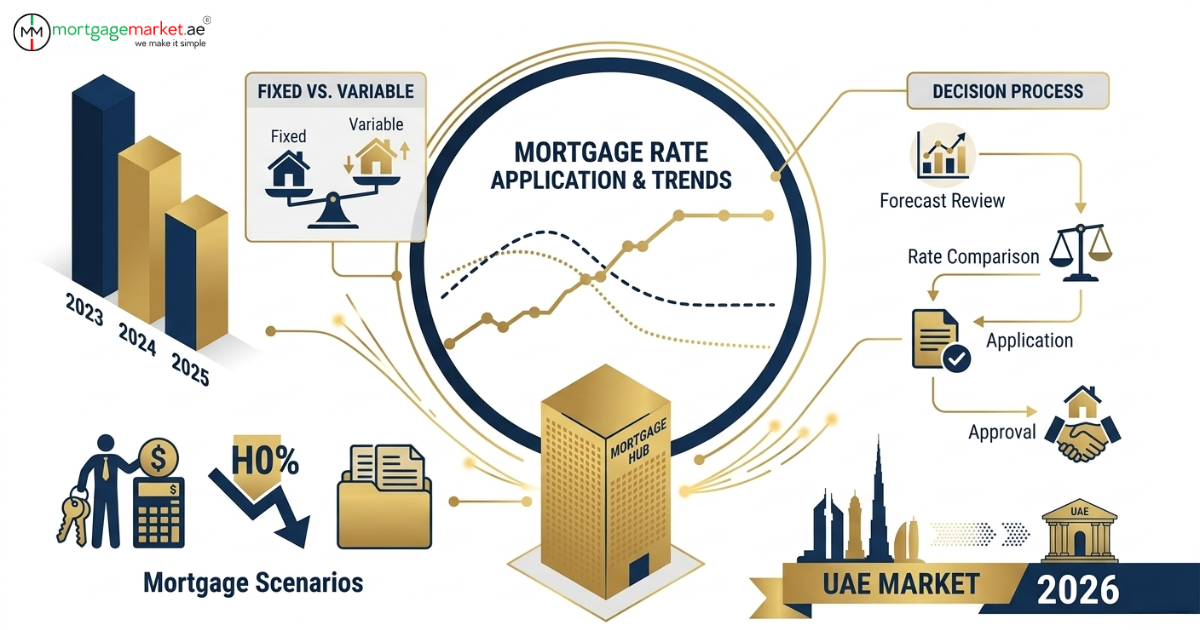
UAE Mortgage Rates 2026: Expert Interest Rate Forecast & EIBOR Trends
Discover the latest UAE mortgage rates in 2026 and.....

Buyout Mortgage Magic: Instantly Find Your Limit
At the center of Dubai’s vibrant property market—where vision collides with creativity—hides a valuable weapon.....

Five Reasons Dubai Is a Safe Place to Buy Property | Mortgage Market
Dubai’s real property marketplace has long been a beacon for worldwide buyers, expats, and dreamers.....

EIBOR as on 30 Apr 2025: 1 MONTH: 4.26% | 3 MONTH: 4.24% | 6 MONTH: 3.99% | 1 YEAR: 4.17%