

How a Low Credit Score Affects Your UAE Mortgage (And How to Fix It)
Struggling with a low credit score in the UAE? It could quietly block your path to owning property in Dubai. This guide breaks down how your AECB score affects mortgage approval, interest rates, and borrowing limits — plus a step-by-step plan to improve your credit and secure better mortgage deals. Whether you're a first-time buyer, expat, or investor, learn how to prepare before applying and avoid costly mistakes.
You've found the apartment. You've done the numbers. You're ready — and then the bank says no.
For thousands of buyers in Dubai every year, a low credit score is the hidden wall between them and their property. It doesn't matter if your salary is strong, your savings are healthy, or the property you've chosen is well within your budget. In the UAE, your credit history follows you everywhere — and if it tells a story of missed payments, maxed-out cards, or unresolved defaults, lenders will listen to it instead of you.
The frustrating part? Most people don't know their score is a problem until they've already applied — and that hard inquiry has already done additional damage.
This guide is for anyone planning to take out a mortgage in Dubai or anywhere in the UAE. We'll cover how the UAE credit system works, exactly how a low score impacts your mortgage (with real numbers), the steps you can take to rebuild it, and how working with the right mortgage broker in Dubai can protect you through the process.
|
📋 What You'll Learn in This Guide How the AECB credit scoring system works in the UAE | What credit score you need for a Dubai mortgage | How a low score affects your rate, loan size, and approval odds | A step-by-step plan to improve your credit before you apply | When a mortgage broker protects you from costly mistakes |
Section 1: How the UAE Credit System Works
What Is the AECB and Why Does It Matter?
The Al Etihad Credit Bureau (AECB) is the UAE's official credit reference agency, established by Federal Law No. 6 of 2010. Every bank, finance company, credit card provider, and even telecom operator that you have a financial agreement with is legally required to report your payment behaviour to the AECB.
This creates a financial fingerprint that follows you across every institution in the UAE. When you apply for a mortgage in Dubai, the bank pulls your AECB report within minutes. Before you've even spoken to a loan officer, they already know your credit history going back years.
How Is Your AECB Credit Score Calculated?
Your AECB score runs from 300 (worst) to 900 (best). While the AECB does not publish the exact weightings of each factor, the primary drivers — consistent with credit bureau methodology globally — are:
|
Factor |
Estimated Weight |
What Moves It |
|
Payment history |
~35% |
On-time vs missed payments |
|
Credit utilisation |
~30% |
Balances vs credit limits |
|
Length of credit history |
~15% |
Age of your oldest account |
|
Credit mix |
~10% |
Loans, cards, overdrafts |
|
New credit inquiries |
~10% |
Hard pulls from applications |
Your payment history and credit utilisation together make up the majority of your score — which means these are also the two areas where you can have the fastest impact when trying to improve.
What Score Range Do UAE Banks Use?
|
Credit Score Range |
Classification |
Mortgage Impact in UAE |
|
750 – 900 |
Excellent |
Best rates, fastest approval, all banks compete for you |
|
700 – 749 |
Good |
Strong approval chances, competitive rates available |
|
650 – 699 |
Fair |
Approval possible but rates are higher, fewer bank options |
|
600 – 649 |
Poor |
Very limited options, banks may impose stricter LTV |
|
300 – 599 |
Very Poor |
Most banks will decline — rebuild before applying |
|
💡 How to Check Your AECB Score Download the AECB app or visit aecb.gov.ae. A full credit report costs AED 84 (including score) or AED 31.50 (report only). It is worth doing this at least 6 months before you plan to apply for a mortgage in Dubai so you have time to address any issues you find. |
Section 2: Exactly How a Low Credit Score Affects Your Dubai Mortgage
A low credit score doesn't just make it harder to get a mortgage in the UAE — it touches almost every dimension of your application. Here's what changes, and by how much.
1. Your Interest Rate Goes Up — By More Than You Think
Banks price risk into every mortgage. The riskier you look on paper, the more they charge. In practical terms, a borrower with a score below 650 may be offered a rate 0.5% to 1.0% higher per annum than someone with a score above 750.
That sounds small. It isn't. Here's what it actually costs you on a typical Dubai mortgage:
|
Loan Amount (AED) |
Rate Difference |
Extra Cost Over 25 Years |
|
1,000,000 |
+0.5% |
Approx. AED 74,000 |
|
1,500,000 |
+0.5% |
Approx. AED 111,000 |
|
2,000,000 |
+0.75% |
Approx. AED 222,000 |
|
3,000,000 |
+1.0% |
Approx. AED 445,000 |
Use our mortgage calculator Dubai to run your own numbers. Enter the loan amount, rate, and term to see your exact monthly payment — and then increase the rate by 0.5% to see the real cost of a weaker credit profile.
2. Your Loan-to-Value (LTV) Ratio May Be Restricted
UAE Central Bank regulations set maximum LTV limits for mortgage borrowers:
• Residents buying a first property under AED 5 million: up to 80% LTV
• Non-residents buying a first property: up to 75% LTV
• Second property purchases: up to 65% LTV
These are the regulatory maximums. Individual banks can — and do — apply lower internal LTV limits for borrowers they consider higher risk. A borrower with a score of 620 may find a bank willing to approve their mortgage, but only up to 70% LTV instead of 80% — meaning they need to put down AED 600,000 on a AED 2 million property instead of AED 400,000. That's an extra AED 200,000 out of pocket before they even move in.
3. Your Mortgage Eligibility Is Directly Reduced
Mortgage eligibility in the UAE is governed by the Debt Burden Ratio (DBR) — a Central Bank rule that limits your total monthly debt obligations (credit cards, personal loans, car loans, AND the new mortgage payment) to a maximum of 50% of your gross monthly income.
A low credit score doesn't directly change the DBR formula, but it signals to banks that you may be struggling to manage your existing commitments. Many lenders apply a more conservative internal DBR cap — often 40% to 45% — for borrowers with poor credit history, reducing how much they'll lend you.
Try our mortgage eligibility calculator in Dubai for a free, instant assessment of how much you may be eligible to borrow across multiple UAE banks. The tool factors in your salary, existing liabilities, and loan term — giving you a realistic picture before you approach any lender.
4. You Face Outright Rejection — And That Makes Things Worse
Below a score of around 580 to 600, most mainstream UAE banks will decline your application outright. This is painful enough on its own. But here's what makes it worse: every formal mortgage application triggers a hard inquiry on your AECB file. Hard inquiries remain on your report for two years and each one marginally reduces your score.
If you apply to three or four banks hoping one will say yes, you may walk away with a lower score than when you started — and a file full of rejection notices that make future lenders even more cautious.
|
⚠️ The Application Trap Never apply to multiple banks simultaneously if your credit score is borderline. A mortgage broker in Dubai will soft-match your profile to the right lenders before any hard inquiry is made — protecting your score throughout the process. |
5. You Have Fewer Bank Choices
The UAE mortgage market includes over 20 active lenders — but not all of them will consider applications from borrowers with scores below 650. Each bank has its own internal credit policy, and these policies are not published. Knowing which bank to approach for your specific profile is one of the most valuable things an experienced mortgage broker in UAE brings to the table.
Islamic banks such as DIB and ADIB sometimes apply slightly different criteria compared to conventional banks — which is another reason why understanding the full market matters before you apply anywhere.
6. Non-Residents Face Additional Scrutiny
If you live outside the UAE and want to buy property in Dubai — whether as an investment or a second home — your mortgage eligibility as a non-resident is already more restricted. A low credit score compounds this significantly. Non-resident mortgage products in the UAE are fewer, carry higher rates, and banks will be even more conservative about credit history from overseas borrowers.
If you're an overseas buyer, speak to a specialist mortgage broker in UAE before starting your property search. Understanding what you can realistically borrow shapes which properties you should be looking at.
Section 3: The Full Picture — What UAE Banks Actually Assess
Your credit score is one piece of the puzzle. UAE mortgage lenders consider a broad set of factors simultaneously. Understanding all of them helps you present the strongest possible application.
Debt Burden Ratio (DBR)
As noted above, the UAE Central Bank limits DBR to 50% of gross monthly income. This is a hard regulatory ceiling. Banks calculate your DBR by adding all monthly debt commitments — including the proposed new mortgage payment — and dividing by your gross salary. If your DBR would exceed 50%, no UAE bank can legally approve your mortgage regardless of your credit score.
Practical implication: if you're carrying a car loan and two credit cards alongside a salary of AED 25,000/month, your available DBR headroom may be significantly lower than you expect. Clearing one loan before applying can dramatically increase what you're eligible to borrow.
Employment Type and Stability
|
Employment Type |
How UAE Banks Typically View It |
|
Salaried — listed public company |
Most favoured: stable, verifiable |
|
Salaried — private company (2+ years) |
Good, especially with salary transfer |
|
Salaried — private (under 1 year) |
Higher scrutiny, may need larger deposit |
|
Self-employed (3+ years, audited accounts) |
Possible but fewer lenders, stricter criteria |
|
Self-employed (under 2 years) |
Very limited options — specialist broker advised |
|
Freelancer / commission-based |
Most difficult — income consistency is key |
Salary Transfer Requirement
Most major UAE banks require you to transfer your salary to them as a condition of mortgage approval. This is different from many other countries — it gives the bank visibility over your income and automatic recourse if you miss a payment. If your employer pays through a different bank, you may need to negotiate a salary transfer waiver, which not all banks offer and which typically comes with a rate premium.
Length of UAE Residency
Banks prefer borrowers who have been in the UAE long enough to demonstrate stability. Newly arrived residents — particularly those with less than 12 months of UAE residency — may face additional questions about their commitment to remaining in the country and their ability to maintain mortgage payments if their employment changes.
Property Type and Location
Banks in the UAE have approved property lists — not every development or building is automatically mortgageable. Off-plan properties, older buildings, and properties in certain free zones may face additional lender restrictions regardless of the borrower's credit profile. A mortgage advisor will check property eligibility before you commit to a purchase.
EIBOR and the Rate Environment
Variable-rate mortgages in the UAE are priced as a margin above EIBOR — the Emirates Interbank Offered Rate. After your initial fixed period ends (typically 1, 2, 3, or 5 years), your rate reverts to EIBOR plus the bank's margin. Understanding where EIBOR is heading matters enormously for long-term affordability.
Track live EIBOR rates in the UAE on our platform. With EIBOR having moved significantly in recent years, knowing the current rate environment is critical when deciding between fixed and variable mortgage products.
Section 4: How to Fix Your Credit Score Before Applying for a Mortgage in Dubai
The most important thing to understand: your credit score is not fixed. It is a living number that responds to your financial behaviour. With a disciplined approach, most people can make meaningful improvements within 6 to 12 months — enough to shift from 'borderline' to 'strong application'.
Here is the complete roadmap, in order of priority.
Step 1: Know Exactly Where You Stand
You cannot fix what you don't understand. Before anything else, pull your full AECB credit report. The report shows every credit account, every payment history entry, and every inquiry — including those you may not recognise.
Read it carefully for:
• Accounts you don't recognise — potential fraud or AECB data errors
• Incorrectly reported late payments — these can be disputed directly with the AECB
• Old defaults that should have expired — most negative entries drop off after 5 years
• High balances on revolving credit (cards, overdrafts) — this is often the easiest quick fix
|
📌 Action Item Download your AECB report before doing anything else. If you find errors, contact the AECB directly via their app or website to raise a formal dispute. Removing even one incorrectly reported negative entry can lift your score significantly. |
Step 2: Aggressively Reduce Credit Card Balances
Credit utilisation — the ratio of your current balance to your credit limit across all cards — is one of the two most heavily weighted factors in your score. The ideal utilisation is under 30%. Above 50% and your score takes a meaningful hit. Above 80% and it becomes severe.
If you have a card with a AED 30,000 limit and a AED 25,000 balance, that's 83% utilisation. Paying it down to AED 9,000 (30%) can produce a noticeable score improvement within one to two statement cycles.
If you cannot pay them down quickly, consider requesting a credit limit increase from your bank — this immediately reduces your utilisation ratio without you paying a dirham, as long as you don't increase your spending.
|
⚠️ Important Requesting a credit limit increase may trigger a hard inquiry depending on the bank. Ask your bank first whether it will require a hard pull, and factor that into your timing. |
Step 3: Build a Perfect Payment History from Today
Payment history is the single largest factor in your AECB score. One missed payment can damage your score by 50 to 100 points — and it stays on your record. Going forward, your single most powerful action is to never miss a payment on anything.
Set up automatic minimum payments on every credit card and loan. This does not mean paying only the minimum forever — it means ensuring no payment is ever missed. Even paying the minimum on time is dramatically better than missing a payment while trying to pay more.
Step 4: Clear All Defaults and Overdue Amounts
If you have any outstanding defaults — even small ones — these must be resolved before any serious mortgage application. A AED 500 default from a telecom bill two years ago can still be sitting on your report dragging your score down.
Contact every creditor with whom you have a reported default. Negotiate a settlement if needed. Once paid, get written confirmation from the creditor and follow up with the AECB to confirm it is updated on your report. This process can take 30 to 60 days, so begin early.
Step 5: Stop Applying for Any New Credit
Every application for a new credit card, personal loan, car finance, or any other credit product triggers a hard inquiry. Multiple inquiries in a short window signal financial desperation to lenders and actively lower your score.
From the moment you decide to pursue a mortgage in Dubai, freeze any new credit applications for at least 6 months. If you need to make a major purchase, pay cash or wait.
Step 6: Strategically Reduce Your Debt Burden Ratio
Even if your credit score is solid, your DBR could still block your mortgage. Before applying, calculate your own DBR:
(Total monthly debt payments including proposed mortgage) ÷ Gross monthly salary = DBR
If you're over 40%, look at which existing loan you could pay off before applying. Clearing a car loan with 18 months remaining eliminates that monthly obligation from your DBR calculation — potentially unlocking significantly more mortgage eligibility.
Run the numbers with our mortgage eligibility calculator UAE to see how reducing one liability changes how much you can borrow.
Step 7: Don't Close Old Accounts
This is counterintuitive but important: closing old credit card accounts — even ones you no longer use — can damage your credit score. Length of credit history makes up roughly 15% of your score. An account you've had for 8 years, even with a zero balance, is contributing positively to your average account age. Keep it open and make a small purchase on it once every few months to keep it active.
Step 8: Consider a Secured Credit Card or Fixed Deposit Loan
If your credit history is thin rather than bad — you simply don't have much of a track record — some UAE banks offer secured credit cards backed by a fixed deposit. Using and repaying this card regularly builds a positive payment history on your AECB file. Some banks also offer small personal loans against fixed deposits for the same purpose. These are slower strategies but valuable for borrowers rebuilding from scratch.
|
✅ Realistic Timeline for Credit Score Improvement 0–3 months: Dispute errors, pay down card balances, clear defaults. You may see early score movement. 3–6 months: Consistent on-time payments begin to accumulate. Score should show meaningful improvement. 6–12 months: Most borrowers with moderate starting scores (580–640) can realistically reach the 650–700 range with discipline. 12+ months: Significant rebuilding from very low scores (below 550) toward mortgage-viable levels (650+). |
Section 5: Special Cases — Self-Employed, Non-Residents, and Expats
Self-Employed Borrowers in the UAE
Getting a mortgage in Dubai when you're self-employed is harder — and a low credit score compounds the difficulty significantly. Where a salaried employee might need 6 months of payslips, a self-employed borrower typically needs:
• 2 to 3 years of audited financial statements
• Trade licence and incorporation documents
• 6 to 12 months of business bank statements
• Personal bank statements showing income consistency
• Evidence of ongoing contracts or revenue streams
If your credit score is below 650 and you're self-employed, your realistic options narrow considerably. Some specialist lenders will consider your case, but rates will be higher and documentation requirements more demanding. Building your credit score before approaching any lender is especially important for self-employed applicants.
Expats and Non-Residents
Expat borrowers living in the UAE with valid residence visas can generally access the same mortgage products as UAE nationals, subject to the same credit criteria. The key differences are:
• Maximum LTV for non-nationals on first properties is 80% (same as nationals under AED 5M)
• Some banks factor in the risk of visa non-renewal when assessing long-term repayment ability
• Salary transfer requirements are the same but some banks have more flexibility for expats banking abroad
Non-residents — people living outside the UAE who want to invest in Dubai property — face a harder landscape. LTV is capped at 75%, rate premiums are significant, and credit score requirements are strict. Some banks will only lend to non-residents from certain nationalities or with certain employment profiles.
If you're an overseas buyer considering mortgage in Dubai, the most important first step is a free eligibility check with a specialist broker before you commit to any property.
UAE Nationals
UAE nationals have access to additional government-backed financing options including Mohammed Bin Rashid Housing Establishment (MRHE) and Sheikh Zayed Housing Programme (SZHP) loans. These programmes have their own credit and eligibility criteria — but a poor AECB score can affect eligibility even here. Maintaining clean credit is important regardless of which financing route you plan to use.
Section 6: If You Already Have a Mortgage — Could a Buyout Save You Money?
If you took out a mortgage in Dubai when your credit score was lower — or when interest rates were higher — and your score has since improved, you may be in a strong position to refinance at a better rate.
A mortgage buyout (also called a balance transfer) involves moving your outstanding mortgage from one UAE bank to another at a lower rate. The saving comes from the difference in interest over the remaining term, minus any exit fees from your current lender and arrangement fees from the new one.
When Does a Buyout Make Sense?
• Your credit score has improved by 50+ points since you originally borrowed
• You are still in your fixed rate period and approaching the end of it
• Current market rates are meaningfully lower than your existing rate
• Your remaining loan term is long enough to recover the switching costs
Our buyout mortgage calculator makes this analysis instant. Enter your current rate, outstanding balance, remaining term, and a target new rate — and the tool calculates your net saving after fees. Many of our clients have saved AED 100,000 to AED 400,000 over their remaining term simply by switching lenders at the right moment.
|
📊 Real Example A borrower with AED 1.8M outstanding at 5.25% with 20 years remaining switches to a new lender at 4.50%. Monthly payment drops by approx. AED 870/month. Total saving over 20 years: approx. AED 208,000 — minus switching costs of around AED 30,000–40,000. Net benefit: AED 165,000–175,000. |
Section 7: Why a Mortgage Broker in Dubai Is Essential When Your Credit Score Is Under Pressure
Going directly to a bank when your credit score is borderline is one of the most common — and costly — mistakes buyers make. Here's the specific problem: banks do not share their internal credit policy thresholds. You won't know whether your score of 635 meets Bank A's requirements until they've pulled your report, declined you, and added a hard inquiry to your file.
A qualified mortgage broker in Dubai operates differently:
Market-Wide Knowledge Without the Credit Damage
An experienced mortgage consultant knows — from daily working relationships with underwriters — which banks are currently most flexible for your specific credit profile. They can assess your situation without triggering a single hard inquiry, then direct your formal application to the lender most likely to approve it on the best terms.
Access to Exclusive Products
Some of the most competitive mortgage rates and products in the UAE are not available directly to the public. They are only accessible through RERA-registered mortgage brokers with volume relationships with the banks. This includes certain fixed rate products, reduced arrangement fee deals, and cashback offers that you will simply not find by walking into a branch.
Full Documentation Support
A mortgage application in the UAE involves a significant amount of paperwork — salary certificates, bank statements, passport copies, property valuation reports, and more. Any documentation error can cause delays or rejections. Your dedicated mortgage advisor at mortgagemarket.ae handles this for you, ensuring your application is complete and correctly presented from day one.
The Broker Costs You Nothing
Mortgage brokers in the UAE are paid by the banks — not by you. The rate you get through a broker is the same as or better than the rate you'd get approaching the same bank directly. There is no premium for using a broker. You get market expertise, multi-bank comparison, and full application support at zero cost to you.
|
Going Directly to a Bank |
Using mortgagemarket.ae |
|
Apply to one bank at a time |
Compare all relevant UAE lenders simultaneously |
|
Hard inquiry with every application |
Soft-match first — protect your credit score |
|
No visibility of internal credit policies |
Direct knowledge of which lenders suit your profile |
|
No access to broker-only rates |
Full access to exclusive products and rates |
|
Handle all paperwork yourself |
Dedicated advisor manages everything |
|
No fee saving — you pay what the bank offers |
Same or better rate — at zero broker cost to you |
|
✅ Free Eligibility Check — No Impact on Your Credit Score Our free mortgage eligibility calculator checks your profile across 5 leading UAE banks simultaneously. No hard inquiry. No commitment. Just a clear picture of what you can borrow and from whom — before you apply anywhere. |
Section 8: Your Complete Action Plan — From Poor Credit to Mortgage Approval
Here's the practical roadmap if your credit score is currently holding you back from a mortgage in Dubai:
12+ Months Before You Want to Buy
1. Pull your AECB credit report. Identify all issues.
2. Dispute any errors or incorrectly reported data with the AECB.
3. Clear all outstanding defaults — even small ones.
4. Begin paying down credit card balances toward 30% utilisation.
5. Set up automatic payments on every account. Never miss another payment.
6. Freeze all new credit applications.
6–9 Months Before You Want to Buy
7. Re-check your AECB score. Assess progress.
8. Calculate your current DBR. Identify any loans you could pay off to increase headroom.
9. Research Dubai property market to set realistic budget expectations.
Use the mortgage calculator UAE with different loan amounts and rates to understand what you can afford at various eligibility levels.
10. Begin saving for your deposit — minimum 20% for residents, 25% for non-residents, plus 4% DLD fee, 2% broker fee (if applicable), and mortgage arrangement fees.
3–6 Months Before You Want to Buy
11. Get a free eligibility assessment from mortgagemarket.ae — no credit impact.
12. Identify which banks are most suitable for your profile.
13. Prepare your document pack: salary certificate, 3 months payslips, 6 months bank statements, passport, visa, Emirates ID.
14. Get a mortgage pre-approval in principle. This strengthens your negotiating position with sellers.
At the Point of Purchase
15. Make your formal mortgage application through your broker to the pre-selected lender.
16. Bank conducts property valuation (cost: approx. AED 2,500–3,500).
17. Receive your formal offer letter.
18. Complete property transfer at Dubai Land Department.
|
🏡 Ready to Start? The earlier you begin, the more options you have. Whether your credit score needs work or you're ready to apply today, our team of mortgage advisors in Dubai is here to guide you through every step — at no cost to you. |
Frequently Asked Questions
What credit score do I need for a mortgage in Dubai?
Most mainstream UAE banks look for an AECB score of at least 650 to consider a mortgage application. The most competitive rates and the broadest choice of products are available to borrowers with scores of 700 and above. Below 600, mainstream approval is very unlikely — specialist advice and a credit improvement plan are needed first.
Can I get a mortgage in the UAE with a bad credit score?
It is possible in some cases, particularly through specialist or smaller lenders who apply more flexible criteria. However, rates will be higher, LTV limits may be lower, and your deposit requirement increases. Working with an experienced mortgage broker in UAE who knows which lenders to approach for your specific profile is essential in this situation.
How do missed payments affect my UAE mortgage application?
Each missed payment on a UAE loan or credit card is reported to the AECB and can reduce your score by 50 to 100 points, depending on how recently it occurred and how overdue the payment became. Missed payments from the last 12 months are viewed most severely. Older missed payments carry less weight but still remain on your file for up to 5 years.
Does having no credit history in the UAE affect my mortgage?
Yes — a thin or absent UAE credit history can be almost as limiting as a poor one. Banks want to see a track record of responsible borrowing and repayment in the UAE. If you've recently arrived, start building UAE credit history immediately: take a credit card, use it lightly, and pay it in full each month. Give yourself at least 12 to 18 months before applying for a major mortgage.
How long does negative information stay on my AECB report?
Most negative entries — including missed payments, defaults, and hard inquiries — remain on your AECB report for up to 5 years from the date of the event. Settled debts and resolved defaults are updated on the report but remain visible. This is why it's critical to maintain clean credit from today, even if you have historical issues.
What is the maximum mortgage I can get in Dubai?
The maximum mortgage eligibility in the UAE is determined by your DBR — your total monthly debt payments cannot exceed 50% of your gross salary. UAE Central Bank LTV rules cap the loan at 80% of property value for residents (first property under AED 5M) and 75% for non-residents. Your actual eligibility depends on your income, existing liabilities, and the bank's assessment of your credit profile.
Check your exact eligibility in under 2 minutes with our mortgage eligibility calculator in UAE.
What is EIBOR and should I choose a fixed or variable rate?
EIBOR is the Emirates Interbank Offered Rate — the benchmark against which variable-rate UAE mortgages are priced. After your fixed rate period, your mortgage reverts to EIBOR + a margin set by the bank. Whether fixed or variable is better depends on where EIBOR is expected to move.
Monitor live EIBOR rates in the UAE and speak to our mortgage advisors to determine which structure makes sense for your situation.
Is it worth using a mortgage broker in Dubai?
For the vast majority of borrowers, yes — especially those with any credit concerns. A RERA-registered mortgage broker gives you access to all UAE lenders simultaneously, protects your credit score during the search process, identifies the most suitable product for your profile, and manages your application at zero cost to you. The broker is paid by the bank, not by you.
What happens if I miss a mortgage payment in the UAE?
Missing a mortgage payment in the UAE is a serious matter. The bank will report it to the AECB immediately, damaging your credit score. Persistent non-payment can lead to legal action, property repossession proceedings, and in some cases, travel bans. If you are struggling to meet payments, contact your lender immediately — most banks have restructuring options that are far preferable to default.
Can I compare mortgage rates in Dubai before applying?
Yes. Our mortgage compare in Dubai tool lets you view current rates from leading UAE banks side-by-side — filtered by your requirements. No application required to browse and compare.
Start Your Mortgage Journey the Right Way
Your credit score is not a verdict — it's a starting point. Whether it's strong enough to apply today, or needs 6 months of work before you're ready, the right plan makes all the difference.
At mortgagemarket.ae, we've helped over 1,000 clients navigate the UAE mortgage market — including many who came to us after initial rejections elsewhere and still went on to secure excellent mortgage deals.
Our services are free. Our knowledge is deep. And we work for you.
Here's how to take the next step:
• Check your eligibility free: Mortgage Eligibility Calculator
• Calculate your repayments: Mortgage Calculator Dubai
• See if a buyout saves you money: Buyout Mortgage Calculator
• Browse current UAE mortgage rates: Compare Mortgage Products
• Monitor the rate environment: EIBOR Rates UAE
• Speak to an advisor today: Contact Us | Call: 800-FINANCE (800-3462623)
How a Low Credit Score Affects Your UAE Mortgage (And How to Fix It)
Struggling with a low credit score in the UAE? It could quietly block.....
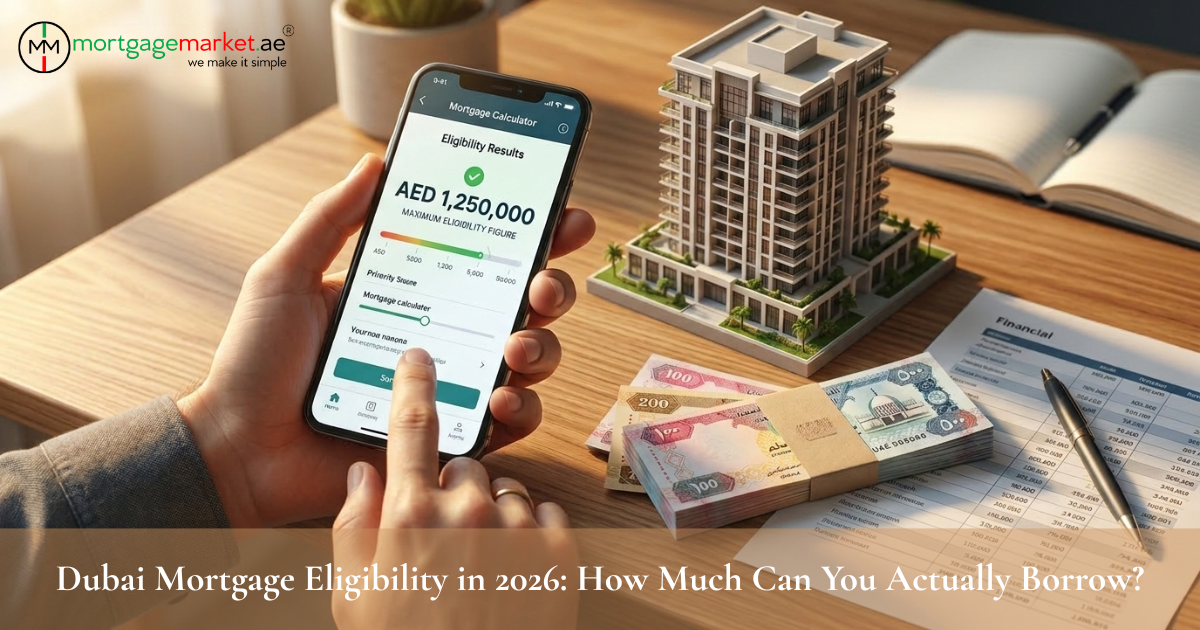
Dubai Mortgage Eligibility in 2026: How Much Can You Actually Borrow?
Buying property in Dubai in 2026? The bank's number is almost.....
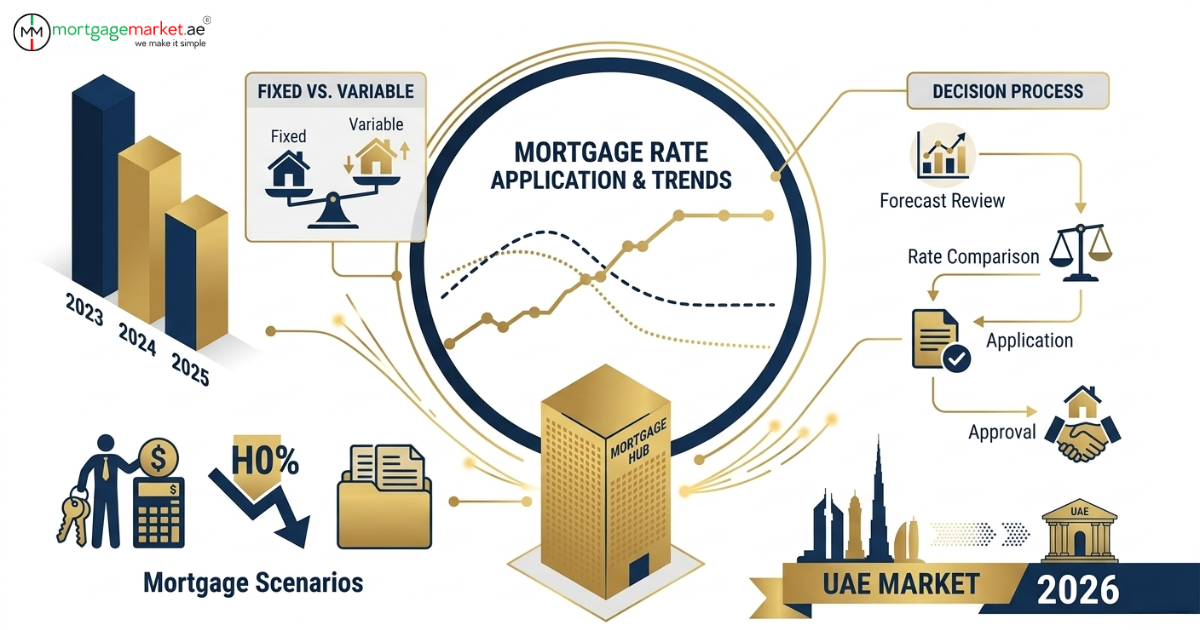
UAE Mortgage Rates 2026: Expert Interest Rate Forecast & EIBOR Trends
Discover the latest UAE mortgage rates in 2026 and.....
UAE Mortgage Rates 2026: Expert Interest Rate Forecast & EIBOR Trends
Discover the latest UAE mortgage rates in 2026 and.....

Buyout Mortgage Magic: Instantly Find Your Limit
At the center of Dubai’s vibrant property market—where vision collides with creativity—hides a valuable weapon.....

Five Reasons Dubai Is a Safe Place to Buy Property | Mortgage Market
Dubai’s real property marketplace has long been a beacon for worldwide buyers, expats, and dreamers.....

EIBOR as on 30 Apr 2025: 1 MONTH: 4.26% | 3 MONTH: 4.24% | 6 MONTH: 3.99% | 1 YEAR: 4.17%