
Buy-to-Let Property in Dubai: Rental Yields, Mortgage Rules and ROI
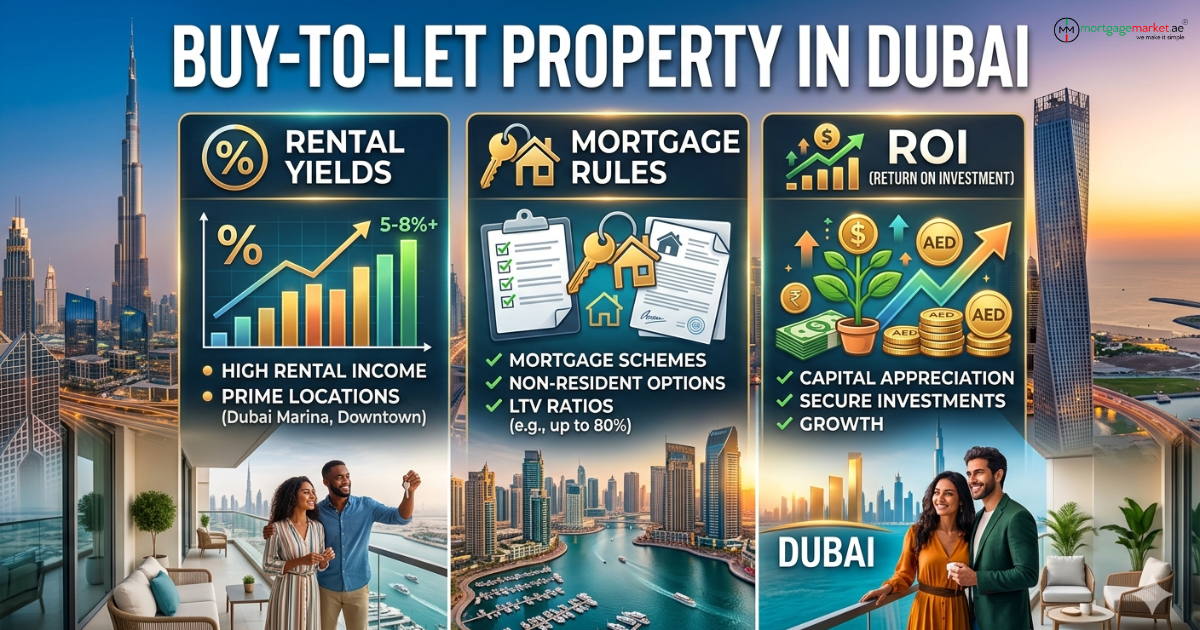
Explore the essentials of Dubai’s buy-to-let market in 2026. From navigating higher down payment requirements and LTV ratios to identifying the highest-yielding neighborhoods like JVC and Business Bay, this guide provides a data-driven roadmap for maximizing your property ROI and securing the best mortgage rates in the UAE.
Dubai has become one of the most watched property investment destinations in the world. Year after year, investors from Europe, Asia, and the wider Middle East are drawn here by the combination of high rental demand, transparent property laws, no annual property tax, and returns that are genuinely difficult to replicate in most other global cities.
But buying a rental property in Dubai is not simply a matter of picking a neighbourhood and signing a contract. To invest successfully, you need a clear understanding of how buy-to-let mortgages work in the UAE, what yields are realistic in different areas, how banks calculate eligibility for investment properties, and how to accurately measure your return on investment once all costs are accounted for.
What Qualifies as a Buy-to-Let Property in Dubai?
A buy-to-let property is one you purchase specifically to rent out rather than occupy yourself. In Dubai, this typically means an apartment, studio, villa, or townhouse in one of the emirate’s designated freehold areas, where both UAE nationals and expatriates (including non-residents) are legally permitted to own property.
Key freehold areas in Dubai that are popular with buy-to-let investors include Dubai Marina, Jumeirah Village Circle (JVC), Business Bay, Downtown Dubai, Dubai Hills Estate, Palm Jumeirah, Jumeirah Lake Towers (JLT), and International City, among many others.
Dubai’s Rental Law, overseen by the Real Estate Regulatory Agency (RERA), governs the relationship between landlords and tenants. All tenancy agreements must be registered through the Ejari system, and rent increases are controlled by RERA’s rental index. This legal framework makes Dubai an attractive market for buy-to-let investors because the rules are clear, enforceable, and generally landlord-friendly compared to many European markets.
As a buy-to-let investor, you earn returns in two ways. The first is rental income — the monthly or quarterly payments your tenant makes under the tenancy agreement. The second is capital appreciation — the increase in the market value of your property over time. When financed through a mortgage, the fundamental goal is to structure the investment so that rental income at minimum covers the monthly loan repayment, with any surplus representing positive cash flow.
Rental Yields in Dubai: A Realistic Picture by Area
Rental yield is the most widely used metric for evaluating a buy-to-let investment. It expresses annual rental income as a percentage of the property’s purchase price. The higher the yield, the faster your rental income covers your initial investment.
It is important to distinguish between gross yield and net yield. Gross yield is simply the annual rent divided by the purchase price. Net yield deducts all running costs — service charges, agency fees, vacancy periods, maintenance, and Ejari registration — from the rental income before calculating the percentage. Net yield is always lower than gross yield and gives a more honest picture of actual returns.
In Dubai, gross yields across different areas and property types in 2026 broadly look like this:
|
Area |
Property Type |
Gross Yield |
Price Range (AED) |
|
International City |
Studio / 1BR |
8–10% |
280K – 600K |
|
Jumeirah Village Circle |
Studio / 1BR |
7–9% |
550K – 1.1M |
|
Business Bay |
Studio / 1BR |
6–8% |
850K – 1.5M |
|
Jumeirah Lake Towers |
1–2 BR |
6–7.5% |
700K – 1.4M |
|
Dubai Marina |
1–2 BR |
5–7% |
1.2M – 2.5M |
|
Dubai Hills Estate |
Villa / Townhouse |
4–5.5% |
2.5M – 6M |
|
Downtown Dubai |
1–2 BR |
4–6% |
1.8M – 4M |
|
Palm Jumeirah |
1–2 BR |
4–5% |
2M – 5M+ |
The pattern here reflects a consistent principle in Dubai property: smaller units in mid-tier locations deliver the highest percentage yields because the entry price is lower relative to achievable rents. Larger, luxury properties deliver lower yields on a percentage basis but offer stronger capital appreciation and attract longer-term, more stable tenants.
For most mortgage-backed buy-to-let investors, areas like JVC, Business Bay, and JLT offer the most balanced combination of accessible purchase prices, strong rental demand, and yields that can genuinely support mortgage repayments from day one.
When running your numbers, subtract approximately 1.5 to 2 percentage points from the gross yield to arrive at a realistic net yield after costs. So a property showing a gross yield of 8% would typically generate a net yield of around 6 to 6.5%.
Buy-to-Let Mortgage Rules in the UAE: What Banks Actually Require
Financing an investment property in Dubai is meaningfully different from financing a home you intend to live in. UAE banks treat buy-to-let applications with greater scrutiny, apply higher down payment requirements, and typically offer lower loan-to-value ratios. Understanding these rules before you start looking at properties will save you time and prevent costly surprises.
Down Payment Requirements for Investment Properties
The minimum down payment for a buy-to-let property depends on your residency status and the purchase price of the property.
UAE nationals purchasing an investment property valued up to AED 5 million are required to put down a minimum of 35%. For properties above AED 5 million, the minimum increases to 45%.
Expatriate residents face a higher threshold. For properties up to AED 5 million, the minimum down payment is 40%, rising to 50% for properties above that value. Non-residents — those without a UAE residency visa — typically need to provide between 40% and 50%, depending on the lender, and some banks require as much as 50% to 60% for non-resident investment buyers.
This stands in contrast to owner-occupied purchases, where expatriate residents can buy with as little as 20% down. The higher down payment for investment properties reflects the additional risk banks associate with lending for non-owner-occupied assets.
Loan-to-Value Ratios on Buy-to-Let Mortgages
The loan-to-value (LTV) ratio is the percentage of the property’s value that the bank is willing to lend. For investment properties in Dubai, UAE banks generally cap LTV at 60% to 65% for residents and 50% to 60% for non-residents.
In practice, this means that if you are buying a rental apartment for AED 1.5 million as a UAE resident, the maximum loan available from most banks would be between AED 900,000 and AED 975,000. The remaining AED 525,000 to AED 600,000 must come from your own funds, in addition to all acquisition costs which are paid separately.
Interest Rates on Investment Property Mortgages
Buy-to-let mortgage rates in Dubai are typically 0.25% to 0.75% higher than rates available on owner-occupier mortgages, reflecting the elevated risk profile of investment lending.
As of early 2026, investment property mortgage rates in the UAE broadly range from 4.2% to 5.5% per annum, depending on the lender, the loan size, and whether you opt for a fixed or variable structure. Fixed rates, which lock in your repayment amount for 2 to 5 years, offer predictability that is particularly valuable when planning cash flow around rental income. Variable rates track EIBOR (the Emirates Interbank Offered Rate) and can move with broader interest rate conditions.
If you want to understand how EIBOR movements affect your mortgage repayments, the EIBOR rates on Mortgage Market tracks current EIBOR figures across 1-month, 3-month, 6-month, and 1-year tenors and is updated regularly.
How Banks Assess Rental Income for Eligibility
One of the more nuanced aspects of buy-to-let mortgage applications in the UAE is how banks treat projected rental income. Some lenders will consider a portion of the expected rental income as part of your total income when calculating eligibility — typically 50% to 70% of projected annual rent. Others assess eligibility purely on your employment or business income and treat rental income as a secondary factor.
This distinction matters significantly if your salary alone does not meet the bank’s minimum income threshold for the loan amount you need. A mortgage broker with experience in investment property finance will know exactly which banks are most receptive to rental income inclusion and how to structure the application to maximise the loan amount available to you.
Mortgage Terms and Loan Amounts
Buy-to-let mortgages in Dubai are available for terms of up to 25 years, though most investment loans are structured over 15 to 20 years. The maximum loan amount available depends on your income, liabilities, and the specific bank’s Debt Burden Ratio (DBR) policy. UAE Central Bank regulations cap total monthly debt obligations at 50% of gross monthly income, which applies to both owner-occupier and investment mortgages.
This means that if you already have existing mortgage commitments, car loans, or credit card balances, these will reduce the amount you can borrow for an investment property. Clearing smaller debts before applying can meaningfully improve your borrowing capacity.
How to Calculate Your ROI on a Dubai Buy-to-Let Property
Return on investment is the metric that ties everything together. A strong headline yield means little if acquisition costs are ignored or running costs are underestimated. The most reliable way to evaluate a buy-to-let investment is to calculate your cash-on-cash return — the annual net income as a percentage of the actual cash you have invested.
The Full Cost of Acquisition
Before running any ROI calculation, you need to know the true total cost of buying the property, not just the purchase price. In Dubai, buyers typically incur the following acquisition costs:
• Dubai Land Department (DLD) transfer fee: 4% of the purchase price. This is the largest single acquisition cost and is non-negotiable.
• Mortgage registration fee: 0.25% of the loan amount, payable to the DLD.
• Property valuation fee: Typically AED 2,500 to AED 3,500, charged by the bank’s appointed valuer.
• Agency commission: 2% of the purchase price if purchasing through a registered real estate agent.
• Mortgage arrangement fee: Typically 1% of the loan amount, charged by the bank or lender.
• Trustee office fee: AED 4,000 for properties priced above AED 500,000.
• Knowledge and Innovation fees: AED 10 each, charged at the point of DLD registration.
On a property purchased at AED 1,200,000 with a 40% down payment (AED 480,000) and a loan of AED 720,000, total acquisition costs would typically add a further AED 65,000 to AED 80,000. Your actual total cash invested from day one is therefore closer to AED 545,000 to AED 560,000 — not AED 480,000.
Annual Running Costs
Once the property is tenanted, the following ongoing costs will reduce your net rental income:
• Annual service charge: Varies significantly by building and location, typically between AED 10 and AED 25 per square foot per year. For a 700 sq ft apartment, this could be AED 7,000 to AED 17,500 annually.
• Ejari registration: AED 220 per tenancy registration, renewed each year.
• Real estate agent’s leasing commission: Typically 5% of annual rent for finding and placing a tenant.
• Property management fee: 5% to 8% of annual rent if you use a property management company, which most overseas investors do.
• Maintenance and repairs: Budget 1% to 2% of the property value annually for routine maintenance.
• Vacancy: Most conservative models budget for one to two months of vacancy per year, even in well-performing buildings.
• Insurance: Home and contents insurance typically costs AED 1,000 to AED 2,500 per year depending on property size and value.
A Worked ROI Example
Here is a detailed calculation for a 1-bedroom apartment in Jumeirah Village Circle purchased at AED 950,000 with a 40% down payment:
|
Item |
Amount (AED) |
|
Purchase price |
950,000 |
|
Down payment (40%) |
380,000 |
|
Mortgage amount |
570,000 |
|
Acquisition costs (DLD, agent, fees) |
62,000 |
|
Total cash invested |
442,000 |
|
Mortgage rate (4.5% fixed, 20 years) |
— |
|
Monthly mortgage payment |
3,610 |
|
Annual mortgage payments |
43,320 |
|
Expected annual rent |
72,000 |
|
Service charge (annual) |
9,500 |
|
Management + agent fees |
5,040 |
|
Maintenance + insurance |
5,200 |
|
Vacancy allowance (1.5 months) |
9,000 |
|
Total annual costs excl. mortgage |
28,740 |
|
Net income before mortgage |
43,260 |
|
Net income after mortgage |
−78 (near breakeven) |
|
Cash-on-cash return (year 1) |
~0% (capital growth play) |
This example illustrates something important: at current rates and yields, a heavily mortgaged buy-to-let investment in Dubai often produces near-breakeven or slightly negative cash flow in the early years. The investment case rests heavily on capital appreciation, equity build-up through loan repayment, and the long-term rental income growth as the mortgage balance reduces.
Investors who want positive cash flow from day one typically need a larger down payment (reducing the loan and therefore monthly repayments), a higher-yielding property in a more affordable area, or a mix of both.
To model your own numbers before speaking to a bank, the mortgage calculator uae lets you input the loan amount, interest rate, and term to see an accurate monthly repayment figure instantly.
Buy-to-Let Mortgage Eligibility: Who Can Apply and What You Need
Buy-to-let mortgages in Dubai are available to a broad range of applicants. UAE nationals and residents can access investment financing from most major banks, while non-residents have a more limited but still viable pathway through a smaller number of lenders.
For UAE Residents
The majority of buy-to-let mortgage applicants are UAE residents — both nationals and expatriates holding a valid residency visa. General eligibility requirements include:
• A minimum monthly salary of AED 15,000 for most banks, though some lenders require AED 25,000 or above for investment property applications
• Employment with a UAE-based employer, or documented self-employment income with at least two years of financial history
• A clean credit record with the Al Etihad Credit Bureau (AECB), with no defaults or significant arrears
• A debt burden ratio (total monthly debt payments including the new mortgage) of no more than 50% of gross monthly income
• Proof of sufficient down payment funds, which in many cases banks will want to see held in a UAE bank account for at least three months
Salaried employees working for government entities, large multinationals, or major UAE corporations are generally viewed more favourably by lenders than those working for smaller or less established businesses. Self-employed investors are assessed differently — banks typically want to see at least two years of audited financials and consistent income.
For Non-Residents
Non-residents — foreign nationals who do not hold a UAE residency visa but wish to invest in Dubai property — can access buy-to-let mortgages from a limited number of UAE banks. The most active lenders in this space include CBD (Commercial Bank of Dubai) and Mashreq Bank, though terms change periodically.
Non-resident requirements are stricter across the board. Banks typically require a minimum income of AED 25,000 to AED 30,000 per month (or equivalent in foreign currency), six months of bank statements from the home country demonstrating affordability, a higher down payment of 40% to 50%, and purchase in designated freehold areas only.
The process is also more documentation-intensive. Passport copies, proof of address in the home country, employment contracts, payslips, and often a credit report from the applicant’s home country are required. Working with a specialist mortgage broker who handles non-resident applications regularly is strongly advisable, as these applications require careful structuring to meet the specific requirements of the small number of banks active in this segment.
For Self-Employed Investors
Self-employed applicants face the most complex assessment process. UAE banks want to see consistent, documented income — typically through trade licences, audited accounts, tax returns (where applicable in the home country), and bank statements. Some banks will average income over two to three years to arrive at the figure used for eligibility calculations, which can reduce the assessed income for applicants with a growing business.
However, self-employed investors with a strong financial profile can absolutely access competitive buy-to-let mortgage products. The key is knowing which banks are currently most receptive to self-employed applications and presenting the documentation in the most favourable way.
Refinancing and Buyout: Improving Your Buy-to-Let Returns Over Time
Buying the property is only the beginning. As a buy-to-let investor, you should be reviewing your mortgage every few years to ensure you are still on a competitive rate. The UAE mortgage market is active and rates evolve — what was a strong deal three years ago may now be significantly above what is available in the market today.
A mortgage buyout (sometimes called a remortgage or refinance) involves transferring your existing home loan from your current bank to a new lender offering better terms. The new lender pays off your existing mortgage, and you begin repayments to them, usually at a lower interest rate. For buy-to-let investors, even a 0.5% reduction in rate on a AED 700,000 loan saves approximately AED 3,500 per year in interest — money that goes directly to improving your net yield.
Before committing to a buyout, you need to weigh the potential savings against the exit costs from your current bank (early repayment charges, if applicable, and the remaining fixed-rate period) and the arrangement costs for the new mortgage (valuation, registration, and arrangement fees). On larger loans, the numbers usually favour switching.
The buyout mortgage calculator makes it straightforward to compare your current mortgage against alternative market rates and see whether switching would improve your monthly position. It is worth running the numbers annually, particularly if your fixed-rate period is expiring and you are about to roll onto a variable rate.
Choosing the Right Area for Your Buy-to-Let Investment
Location is the single most important variable in any buy-to-let investment. But the ‘right’ location depends entirely on your investment objective. If you want the highest yield, the answer is different from if you want the safest capital preservation, and both are different from if you want the easiest property to keep tenanted year-round.
High-Yield Locations
Areas like International City, Discovery Gardens, and Jumeirah Village Circle consistently deliver the highest gross yields in Dubai, often in the 7% to 10% range. These are areas with high tenant demand driven by mid-income working professionals, affordable service charges, and lower purchase prices that improve the yield calculation. The trade-off is slower capital appreciation compared to more prestigious addresses.
Balanced Yield and Appreciation
Business Bay, Jumeirah Lake Towers, and Dubai Silicon Oasis occupy the middle ground. Yields in the 6% to 8% range combine with reasonable growth prospects, good transport links, and sustained rental demand from the large corporate workforce in these areas. For most first-time buy-to-let investors using a mortgage, this segment often makes the most financial sense.
Luxury and Capital Growth Plays
Downtown Dubai, Dubai Marina, and Palm Jumeirah attract investors who prioritise long-term capital appreciation over immediate yield. Gross yields in the 4% to 6% range are lower, but the quality of the tenant profile is higher, vacancy rates are lower for well-maintained units, and the properties themselves have historically seen stronger price growth. These areas are better suited to investors with larger down payments and a longer investment horizon.
Working with a Mortgage Broker for Your Buy-to-Let Investment
A buy-to-let mortgage application is more complex than a standard residential purchase. Banks apply stricter criteria, the documentation requirements are heavier, and the number of lenders actively writing investment loans at any given time is smaller than for owner-occupied finance.
Working with an experienced mortgage broker does not just save you time. It materially improves the outcome in several specific ways.
First, a broker has current knowledge of which lenders are actively offering competitive buy-to-let rates and which have quietly tightened their criteria — information that is not publicly available and changes regularly.
Second, brokers can access rates and products that are not available to borrowers applying directly. Banks frequently offer preferred terms to broker-introduced clients as part of volume-based commercial arrangements.
Third, for investors with more complex income profiles — self-employment, multiple income streams, overseas earnings, or rental income from existing properties — a broker who knows how each bank’s underwriters think can structure the application to maximise the likelihood of approval at the best available terms.
Finally, brokers manage the full process from initial assessment through to mortgage offer and completion, coordinating with the bank, the valuer, and the DLD on your behalf. For investors who do not live in Dubai full time, this is particularly valuable.
Mortgage Market has been active in UAE mortgage finance for over 15 years. The team covers residential mortgages, buy-to-let investment finance, and mortgage buyouts, with specialist consultants who understand the distinct requirements of each.
Frequently Asked Questions
Can I get a buy-to-let mortgage in Dubai as a non-resident?
Yes, a limited number of UAE banks offer buy-to-let mortgages to non-residents. Down payment requirements are higher — typically 40% to 50% — and banks will require six months of overseas bank statements, proof of income, and a passport copy. The pool of active lenders for non-resident investment mortgages is smaller, so working with a broker who specialises in this area is highly recommended.
What is the minimum salary required for a buy-to-let mortgage in the UAE?
Most UAE banks require a minimum monthly salary of AED 15,000 for buy-to-let mortgage applicants, though some lenders set their threshold at AED 25,000 specifically for investment property applications. Self-employed applicants are assessed on documented net income, typically averaged over two years of audited accounts.
Will rental income count towards my mortgage eligibility?
It depends on the lender. Some UAE banks will include a portion of projected rental income — usually 50% to 70% of the expected annual rent — when calculating your total income for eligibility purposes. Others rely exclusively on employment income. This is one of the most important variables to clarify before choosing which bank to apply with.
Is there a property tax on buy-to-let income in Dubai?
No. Dubai does not levy annual property tax, capital gains tax, or income tax on rental earnings. The only government charges you will pay are the one-time Dubai Land Department transfer fee (4% of the purchase price), the mortgage registration fee (0.25% of the loan amount), and the annual Ejari tenancy registration fee (AED 220). This tax-free environment is one of the most powerful advantages of investing in Dubai property compared to most other major markets.
What are typical rental yields in Dubai in 2026?
Gross rental yields in Dubai currently range from approximately 4% in luxury areas like Palm Jumeirah and Downtown Dubai to 8% to 10% in more affordable locations like International City and Jumeirah Village Circle. Net yields, after deducting service charges, management fees, vacancy, and maintenance, are typically 1.5 to 2 percentage points below gross yield.
How long does a buy-to-let mortgage application take in the UAE?
Pre-approval typically takes one to three working days when using a mortgage broker who submits a complete application. Full mortgage offer, following property valuation, usually takes seven to fourteen working days from valuation. The entire process from initial application to receiving the mortgage offer letter is typically three to four weeks, assuming documentation is in order.
Can I use the rental income from my investment property to buy another one?
In theory, yes — if rental income is accepted by the bank as part of your income assessment, it can support eligibility for a second investment loan. In practice, UAE banks also look at your total liabilities and apply the 50% Debt Burden Ratio cap to all combined monthly obligations. As your portfolio grows, you will need to manage your DBR carefully to maintain borrowing capacity.
What happens if my tenant does not pay rent while I have a mortgage?
This is the practical risk every landlord must account for. In Dubai, landlords have legal recourse through the Rental Dispute Settlement Centre if a tenant defaults on rent. However, enforcement takes time, and the mortgage repayment remains due regardless. This is why most experienced buy-to-let investors maintain a cash reserve of at least three to six months of mortgage repayments to cover vacancy or dispute periods.
Is Dubai Buy-to-Let Still Worth It in 2026?
The short answer is yes — but with realistic expectations. Dubai’s property market in 2026 is characterised by continued population growth, sustained rental demand, and a legal environment that has matured significantly over the past decade. Investors entering the market now benefit from a more transparent, better-regulated system than at any previous point in Dubai’s real estate history.
The key shift in recent years is that buy-to-let investment here increasingly resembles mature global markets. The era of easy double-digit yields everywhere is largely over in the most accessible and well-connected locations. Yields are still strong by international standards, but sustainable investment now requires proper financial analysis, realistic cost modelling, and a clear view of your investment timeline.
Investors who approach Dubai buy-to-let with a five-to-ten-year perspective, account honestly for all acquisition and running costs, choose a location that matches their financial objective, and secure competitive mortgage financing from the outset are still very well positioned. The fundamentals — no property tax, high rental demand, legal clarity, and genuine yield advantage over most comparable global cities — remain intact.
The biggest variable within your control is the mortgage. Securing the right rate, the right structure, and the right loan-to-value ratio has a larger impact on your long-term returns than most investors realise. A difference of 0.5% on the interest rate across a 20-year mortgage on a AED 700,000 loan is over AED 70,000 in total interest. This is why getting the financing right matters as much as getting the property right.
Ready to Finance Your Dubai Investment Property?
Mortgage Market has helped over 1,000 clients finance property across Dubai and the UAE. Our consultants will assess your eligibility across leading UAE banks, identify the most competitive buy-to-let mortgage for your situation, and manage the entire application process from start to finish — at no cost to you.
→ Check your mortgage eligibility across UAE banks in minutes



UAE Mortgage Rates 2026: Expert Interest Rate Forecast & EIBOR Trends
Discover the latest UAE mortgage rates in 2026 and how EIBOR.....
Self-Employed in the UAE? 15 Ways to Guarantee Your Mortgage Approval in 2026
Self-employed in the UAE? Getting mortgage approval doesn’t have to be complicated. Discover.....

The main reasons why a mortgage application is rejected
Applying for a mortgage is one of the most significant financial steps in purchasing a.....

EIBOR as on 31 Mar 2026: 1 MONTH: 3.65% | 3 MONTH: 3.66% | 6 MONTH: 3.71% | 1 YEAR: 3.91%